
The Dark Knight: How Chicago Became Gotham
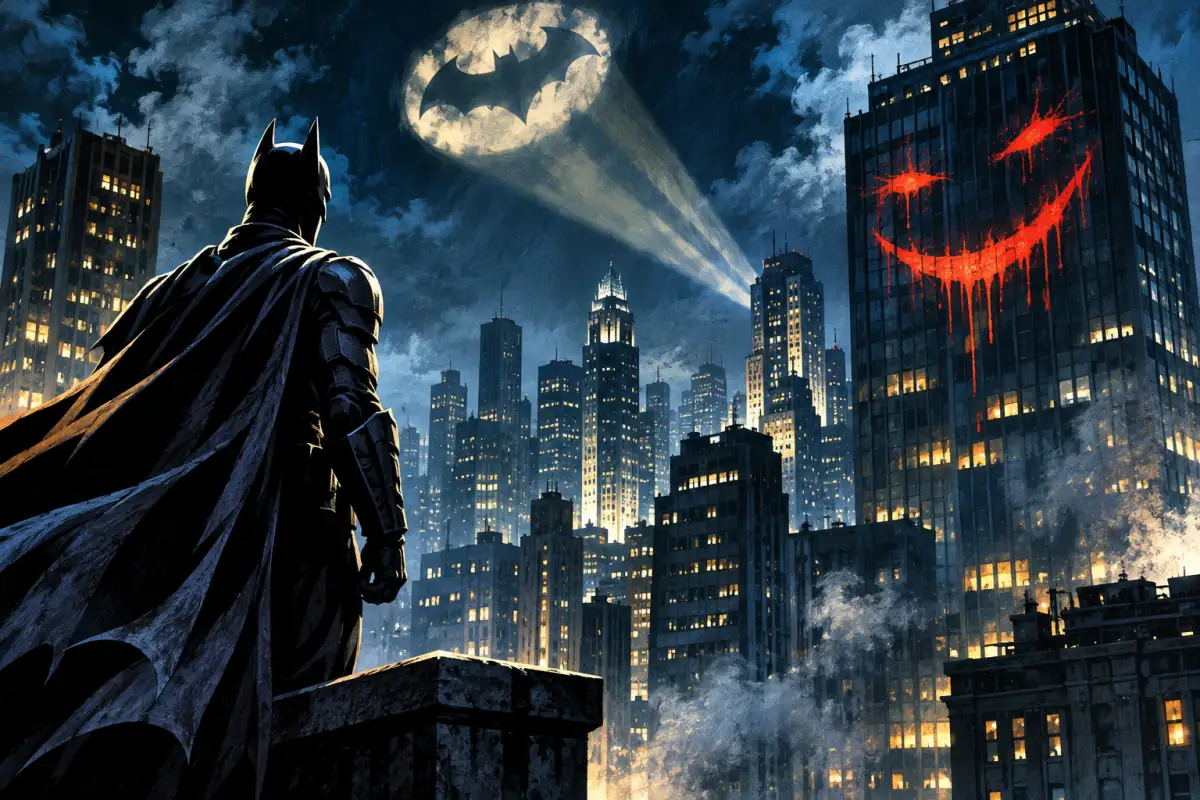
- The Film at a Glance
- The Dark Knight: The Trailer
- Filming Locations: Where Gotham Came to Life
- A Camera Test in the Backyard
- The People Behind Gotham's Faces
- Harvey Dent's Changing Coin
- How Ledger Found the Joker
- Putting the Chase on Real Streets
- The Dark Knight’s Chase Through Gotham
- The Hospital Had One Chance to Fall
- Giving the Joker and Dent Their Own Sound
- The Dark Knight: “Aggressive Expansion”
Creating Gotham for The Dark Knight meant turning a Chicago post office into a bank and flipping a real truck on a city street. Director Christopher Nolan and his crew brought the chaos to life through carefully planned stunts, with England and Hong Kong supplying more of Batman's world.
At the center of that world is Christian Bale's Bruce Wayne, a billionaire who fights crime as Batman. His allies are police officer Jim Gordon and Harvey Dent, the lawyer prosecuting the city's mob bosses. Then Heath Ledger's Joker arrives, turning their progress into a much harder fight.
Spoilers ahead for the 2008 film.
The Film at a Glance
The crew began with the opening bank robbery, filming in Chicago ahead of the main shoot.
| Milestone | Date or Place |
|---|---|
| Advance Chicago filming began | April 18, 2007 |
| Production | Filmed during 2007 in Chicago, England and Hong Kong |
| U.S. theatrical release | July 18, 2008 |
The April filming dates cover that early Chicago work. Here's the official trailer for a quick return to the story.
The Dark Knight: The Trailer
Filming Locations: Where Gotham Came to Life
Bruce's penthouse bedroom was filmed in a hotel, while the IBM Building supplied offices for several characters. These Chicago filming locations helped a few real buildings play several parts in Gotham.
The table uses the buildings' names during production. The hospital row identifies a former site because the building was demolished for the scene.
| Real Location | Address | What It Became on Screen |
|---|---|---|
| Old Chicago Main Post Office | 404 West Harrison Street, Chicago, Illinois, United States | The bank in the opening robbery |
| Lower Wacker Drive and South LaSalle Street | Downtown Chicago, Illinois, United States | Chase roads; the truck flips on South LaSalle Street |
| Former Brach's factory site | 401 North Cicero Avenue, Chicago, Illinois, United States | Gotham's hospital exterior; the filmed building was demolished |
| IBM Building | 330 North Wabash Avenue, Chicago, Illinois, United States | The Wayne Enterprises boardroom and offices for Dent and city officials |
| Hotel 71 | 71 East Wacker Drive, Chicago, Illinois, United States | Bruce Wayne's penthouse bedroom |
| Trump Tower, under construction during filming | 401 North Wabash Avenue, Chicago, Illinois, United States | The tower exterior for Batman's confrontation with the Joker |
| Farmiloe Building | 28–36 St John Street, Clerkenwell, London, England, United Kingdom | Gotham police-station interiors |
| Hangar 2, Cardington Airfield | Bedford, Bedfordshire, England, United Kingdom, MK42 0TF | A built set for the tower-fight interior |
| Two International Finance Centre | 8 Finance Street, Central, Hong Kong Island, Hong Kong SAR, China | Batman's Hong Kong mission involving Lau, the mob's financial contact |
Batman and the Joker's tower fight brings two distant locations together. The outside was in Chicago, but the crew re-created the interior at Cardington in England. Cut together, they become one building on screen.
Cardington would also house the revolving hallway in Nolan's Inception, where a built set helped make another unlikely scene work.
A Camera Test in the Backyard
Before filming Gotham's action, Nolan and Wally Pfister, who led the camera work, tried out IMAX cameras at Nolan's home. They filmed in his backyard and garage, then put a camera in the back of a pickup and drove along Sunset Boulevard at night.
IMAX records a much larger film image than ordinary 35mm cameras. The night footage showed clear detail even in the darkest areas, encouraging Nolan and Pfister to use IMAX for major action scenes. The finished movie mixes those large images with scenes shot on 35mm film.
The People Behind Gotham's Faces
Bale and Ledger anchor the conflict, but Bruce also needs help from people who know him without the mask. Michael Caine plays Alfred, his butler and adviser, while Morgan Freeman's Lucius Fox helps equip Batman.
The ages below use April 18, 2007, the advance Chicago shoot's opening day, as a shared reference. That wasn't necessarily each actor's first day on set; the later column uses October 31, 2026.
| Performer | Character | Date of Birth | Age on April 18, 2007 | Age or Status on October 31, 2026 |
|---|---|---|---|---|
| Christian Bale | Bruce Wayne / Batman | January 30, 1974 | 33 | 52 |
| Heath Ledger | The Joker, Batman's criminal opponent | April 4, 1979 | 28 | Died at 28 in 2008 |
| Aaron Eckhart | Harvey Dent, Gotham's district attorney, later Two-Face | March 12, 1968 | 39 | 58 |
| Maggie Gyllenhaal | Rachel Dawes, a lawyer and Bruce's longtime friend | November 16, 1977 | 29 | 48 |
| Gary Oldman | Jim Gordon, Gotham police officer and Batman's ally | March 21, 1958 | 49 | 68 |
| Michael Caine | Alfred, Bruce's butler and adviser | March 14, 1933 | 74 | 93 |
| Morgan Freeman | Lucius Fox, who helps equip Batman | June 1, 1937 | 69 | 89 |
Ledger's Earnings Estimate
Ledger's deal reportedly included shares of film revenue and merchandise income. Forbes estimated his overall earnings for October 2007–October 2008 at $20 million (about $31.3 million in September 2026 dollars), before taxes, management fees and other costs. That was an annual earnings estimate, not a confirmed salary for The Dark Knight.
The inflation comparison uses the 2008 annual-average consumer price index and the September 2026 index, with 2008 as a rough starting point for earnings spanning two years.
Harvey Dent's Changing Coin
Dent's lucky coin begins with a trick: both sides show heads. His apparent gamble has a result he already knows. Later, one side is scarred, and the coin follows his transformation from district attorney into Two-Face.
The small prop tells part of Dent's story for him. As his faith in the law breaks down, the once-rigged coin gives chance a say in what he does next.
The Two-Face replica coin below brings that two-headed, scarred design to a fan costume or collection.

- Give costume coin flips the weight and sound of metal.
- Recreate Two-Face's coin reveal with clean and scarred sides.
- Add a pocket-sized finishing touch without carrying a bulky prop.
How Ledger Found the Joker
Makeup artist John Caglione Jr. had to work against his training to create the Joker's face. His early attempts had clean clown lines, while this character needed to look as though he'd left his makeup on for days.
Nolan brought in work by painter Francis Bacon, whose blurry images helped guide Caglione and Ledger toward the Joker's smeared, worn makeup. Getting it to look that messy took careful work.
Ledger was also figuring out how the Joker moved. During filmed costume and makeup tests, he tried coats and props, exploring how they changed his walk and gestures. He even applied the makeup himself once or twice during preparation to see how the character would do it. The tests let him work out the clothes, face and movement together.
Ledger finished his work on The Dark Knight but died on January 22, 2008, aged 28, before its release. The medical examiner ruled his death accidental, caused by the combined effects of medications. His performance as the Joker earned him the 2009 Oscar for supporting actor, awarded after his death.
Putting the Chase on Real Streets
Chris Corbould, who supervised the physical effects, wasn't sure he could flip the truck Nolan wanted. He suggested a smaller vehicle or flipping just the trailer. Nolan held out for the whole truck, so Corbould's team built a device that used compressed gas to tip it over. The test worked.
Getting it to work on LaSalle Street was another problem. Utilities and bank vaults beneath the road limited where the device could safely push against the ground. The crew found a suitable spot, and the truck went over with a stunt driver inside, protected by a reinforced compartment.
The Bat-Pod, Batman's wide-wheeled, motorcycle-like machine, brought its own troubles. It could be ridden, but it handled so differently that specialist rider Jean-Pierre Goy avoided normal motorcycles while filming the sequence. Switching between the two confused him.
Watch the finished chase below to see the vehicles in action.
The Dark Knight’s Chase Through Gotham
The Tumbler is Batman's armored-looking car, with a design carried over from Batman Begins. The Jada die-cast collectible below is a 1:24 model with a Batman figure.

- Create a car-and-hero scene without buying a separate Batman figure.
- Explore the model more closely through its opening doors.
- Fit the Tumbler alongside other 1:24 vehicles in your collection.
The Hospital Had One Chance to Fall
For Gotham's hospital, the crew used an empty building at the Brach's factory site. A demolition company brought it down, while the movie effects crew added the bursts seen around it.
The camera crew covered the demolition from several angles because the building couldn't be put back for another take. Ledger had to perform his part within that carefully planned event.
The pause as the Joker fiddles with the detonator was planned. Repeated rehearsals and a break between explosions let Ledger move through the shot safely. The Joker's moment of confusion gave the actor time to reach the right place before the building came down.
Giving the Joker and Dent Their Own Sound
Hans Zimmer and James Newton Howard wrote the score, the music composed for the film. They divided part of the work by character: Zimmer focused on the Joker, while Howard focused on Harvey Dent. They shared work on other parts.
Zimmer spent months searching for the simple sound he had in mind for the Joker.
Listen to their work in “Aggressive Expansion,” a soundtrack selection credited to both Zimmer and Howard.
The Dark Knight: “Aggressive Expansion”
Ready to test how much of Gotham you remember? Try the Dark Knight quiz, or follow Nolan's crew into another movie below.
The Dark Knight Quiz: Some Men Just Want to Watch You Fail

Inception: The Real Work Behind the Dream
Interstellar: From Cornfields to the Edge of Space