Inception: The Real Work Behind the Dream

Dom Cobb has an unusual way of stealing secrets: he enters people's dreams. Played by Leonardo DiCaprio, he's good at taking ideas out of sleeping minds. In Inception, his new assignment runs the other way. He must plant an idea and make it feel like it belongs there.
Writer-director Christopher Nolan gave that job a world where streets can fold overhead and a hotel corridor can turn upside down. Getting those dreams onto the screen meant giving real people some very strange working conditions.
Spoilers ahead for the 2010 film.
The Film at a Glance: Filming took place in 2009. After work in Japan, the UK shoot began July 13, 2009. The US theatrical release followed on July 16, 2010.
Turning a Dream Into a Movie
Nolan had spent about ten years developing the script by the film's release. He was fascinated by the mind's ability to create a whole world during sleep, then accept that world while experiencing it.
For the movie to work, those places had to feel convincing. Nolan used handheld cameras to give the dream scenes a sense of ordinary life, with computer effects extending what the camera captured. A street should look like a street before it starts behaving very badly.
Even a small object could carry a big worry. Cobb uses a spinning top as a totem, a personal object meant to help him check whether he's inside someone else's dream. The movie-inspired top below brings that reference to a desk, where its job is a hands-on break.
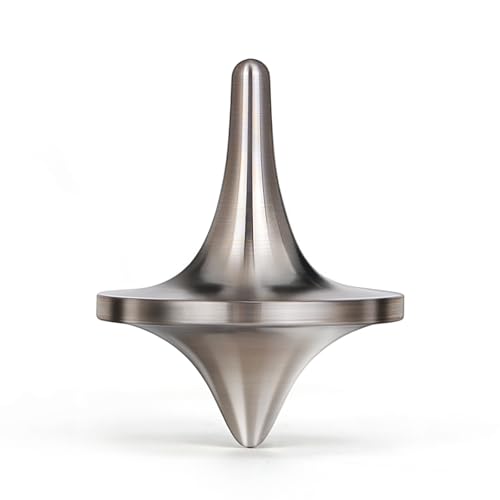
- Give your hands something to do during a short break from screens.
- Enjoy a simple desk toy with no batteries or charging.
- Add a subtle movie reference without taking over your workspace.
The Cast Behind the Dream Team
Elliot Page plays Ariadne, who learns to shape dream worlds. Her lessons give us a way into Cobb's unusual line of work. Joseph Gordon-Levitt plays Arthur, whose hotel scenes gave him much more to do than learn his lines.
Here are eight of the faces behind the story. The filming-age column uses July 2009 as a shared reference month. The final column gives their ages on October 31, 2026.
| Performer | Character | Birth Date | Age in July 2009 | Age on Oct. 31, 2026 |
|---|---|---|---|---|
| Leonardo DiCaprio | Dom Cobb | November 11, 1974 | 34 | 51 |
| Joseph Gordon-Levitt | Arthur | February 17, 1981 | 28 | 45 |
| Elliot Page | Ariadne | February 21, 1987 | 22 | 39 |
| Tom Hardy | Eames | September 15, 1977 | 31 | 49 |
| Marion Cotillard | Mal | September 30, 1975 | 33 | 51 |
| Ken Watanabe | Saito | October 21, 1959 | 49 | 67 |
| Cillian Murphy | Robert Fischer | May 25, 1976 | 33 | 50 |
| Michael Caine | Miles | March 14, 1933 | 76 | 93 |
DiCaprio's deal also tied him to the movie's success. In August 2010, Forbes estimated that he stood to earn at least $50 million from box-office-linked payments—about $77 million in September 2026 dollars. That was an earnings forecast, not a confirmed upfront salary or final total.
The inflation comparison uses US consumer-price figures for 2010 and September 2026.
The Real Places Inside the Dream
The production traveled through six countries: Japan, the United Kingdom, France, Morocco, the United States and Canada. On screen, those places could take on entirely different identities.
Cobb visits a school in Paris, but its gallery and lecture theatre were at University College London. His chase through Mombasa, Kenya, was filmed in Tangier, Morocco. Even before the effects team started folding streets, the movie was rearranging the map.
| Scene | Filming Site and Address |
|---|---|
| Cobb and Ariadne at the Paris café | 6 Rue César Franck, at Rue Bouchut, 75015 Paris, Île-de-France, France |
| Ariadne's bridge-building lesson | Pont de Bir-Hakeim, Paris, Île-de-France, France |
| The fictional Paris school | UCL, Gower Street, Bloomsbury, London, England, United Kingdom, WC1E 6BT |
| Cobb's chase in Mombasa | Old city streets and market, Tangier, northern Morocco |
| The hotel corridor sets | Hangar 2, Cardington Airfield, Bedford, Bedfordshire, England, United Kingdom, MK42 0TF |
| The train tearing through a city street | South Spring Street at West 7th Street, Downtown Los Angeles, California, United States |
| Snow-fortress exteriors | Fortress Mountain, Kananaskis Country, Alberta, Canada |
At UCL, the Flaxman Gallery supplied the meeting with Ariadne, while the Gustave Tuck Lecture Theatre became the classroom of Miles, Michael Caine's character. Cardington had a different assignment: provide enough room to build a hotel that could move.
Making Paris Come Apart
Ariadne's café lesson turns a quiet conversation into flying debris. The actors really did sit amid physical blasts: the crew used air-powered devices to throw lightweight material through the street.
Cameras recorded many images each second, allowing the action to play back in slow motion. Digital artists then added destruction and changed the timing, making the debris seem to hang in the air. The finished scene combines something the actors could react to with movement that feels wrong for the waking world.
Then Paris folds over itself. For that, the effects team built detailed computer versions of the buildings using scans and photographs. The rising streets also needed moving cars and people; a frozen city would have spoiled the trick.
Paul Franklin, who supervised the visual effects, found a useful model in Chicago's opening drawbridges. As a bridge rises, its road and sidewalks seem to lift on a giant hinge. That gave the impossible city a familiar kind of movement.
Back on the real Paris street, Nolan held a laptop showing a rough animation to guide DiCaprio and Page's reactions. Their job was to look up at a city that hadn't moved an inch.
Take a short trip behind the Paris dream sequence in this featurette.
A Hallway With No Reliable Floor
Arthur's hotel fight gave Gordon-Levitt a more physical problem. At Cardington, the crew built a 100-foot corridor that revolved, with a camera track fitted into its floor. As the set turned, walls and ceiling became surfaces for the fight.
Nolan had admired the rotating set in 2001: A Space Odyssey since childhood. Here was a chance to bring that kind of illusion into an action scene.
It still required careful timing. Performers had to jump at the right moment, while a crew member stayed ready at the emergency stop switch.
The floating action needed a different setup. A separate corridor stood vertically, with the camera looking up and performers suspended on wires. Digital artists erased visible supports and added floating objects.
Gordon-Levitt threw himself into the work. Nolan remembered him performing all but one shot during three weeks of zero-gravity filming, despite having a matching stunt double ready. That's quite a stretch of work for a character in a suit.
Arthur also carries a much smaller piece of equipment: a loaded die, whose weight and balance he keeps private. The red dice below borrow that movie association for game night; they're ordinary game dice, rather than Arthur's specially weighted totem.

- Read rolls quickly thanks to bright white pips on red dice.
- Cover games that need multiple dice with a matching set of five.
- Give a game fan a neatly presented set wrapped in gold foil.
A Train on the Road, Cameras on Skis
Out on the Los Angeles street, the runaway locomotive had a truck underneath it. Production designer Guy Dyas's team built the engine's shell on the frame of an 18-wheeler. Wally Pfister, who led the camera work, shook the camera himself to suggest the force of the approaching train. Sometimes the direct approach does the job.
The snowy chase called for a crew that could keep up. Camera operator Chris Patterson filmed while skiing, with assistant Scott DaHarb skiing behind him and adjusting focus.
The fortress had several versions, too. The crew filmed on a set on the mountain, then used computer-built views to show the larger structure. For the collapse, they destroyed a model at one-sixth scale.
Music That Keeps the Dream Moving
Hans Zimmer wrote the score—the music composed for the film. But the team inside the story also depends on an existing recording: Édith Piaf's “Non, je ne regrette rien.” It warns the dreamers that a “kick,” the jolt used to wake them, is coming.
There was an unusual casting connection. Marion Cotillard had previously played Piaf. Nolan already had the song in the script before she joined; he then asked Zimmer to work it into the music.
The song had to stretch as the action moved between dream levels. Music editor Alex Gibson explained that the team slowed it by different amounts, while keeping it recognizable. Following the story's time changes exactly would have stretched it too far for that.
Sound effects helped connect the layers, too. Sound supervisor Richard King described turning the roar inside the airplane into traffic noise as the film enters the first dream.
Gibson remembered Nolan asking Zimmer to build up “Time,” with Johnny Marr's guitar added along the way. Give the track a listen on its own, without a folding city competing for your attention.
The Dream Reaches the Screen
Inception brought in about $828 million in worldwide ticket sales during its original release. Its reported production budget was $160 million; ticket receipts aren't the same as studio profit.
At the 2011 Academy Awards, it won four Oscars: Cinematography, Sound Editing, Sound Mixing and Visual Effects.
Put your memory of Cobb's mission to work with our Inception quiz.
The Inception Quiz: A Quiz Within a Quiz

The Matrix Unplugged: How the Movie Came to Life
Behind the Walls of The Shawshank Redemption