Gladiator: From Muddy Woods to a Roaring Arena
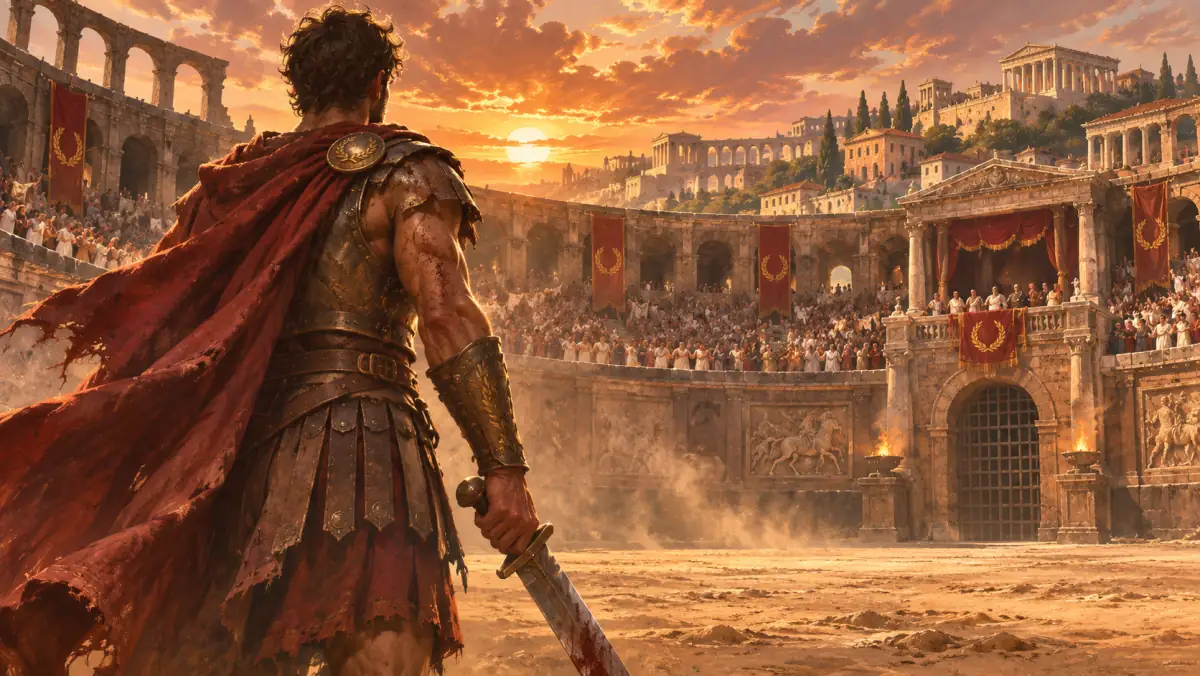
Come behind the scenes of Gladiator, where Russell Crowe's Maximus, a Roman general, is betrayed and forced to fight in the arena. His journey begins in a forest filmed in England, then takes him through worlds built in Morocco and Malta. Getting those places to feel like one ancient world took mud bricks, repurposed timber and some clever work at a computer.
Spoilers ahead for the 2000 film.
The Film at a Glance
The crew spent the first part of 1999 filming Maximus's journey. Audiences met him the following year.
| Film Detail | What to Know |
|---|---|
| Director | Ridley Scott |
| Credited Writers | David Franzoni, John Logan and William Nicholson |
| Main Filming | January–May 1999 |
| U.S. Theatrical Release | May 5, 2000 |
| Original Theatrical Runtime | 155 minutes (2 hours 35 minutes) |
| U.S. Rating | R |
Paramount's official trailer offers a quick return to Maximus's world:
Gladiator: The Trailer
The Painting That Opened the Arena
Scott's way into the film began with a painting. He recalled Walter Parkes unrolling a large reproduction of a gladiator scene. Seeing it convinced him to direct.
The work was Jean-Léon Gérôme's Pollice Verso (Thumbs Down), painted in 1872. Long before the crew built an arena, Scott had an image that made him want to enter one.
The screenplay took longer to settle. Producer Doug Wick described a story developed through several writers, starting with David Franzoni. He credited John Logan with developing the loss of Maximus's family. William Nicholson helped make the ending work after Crowe raised concerns about the script.
Changes continued during filming. John Mathieson, who led the camera work, described how rewrites made it difficult to prepare the lighting ahead of time. A change on the page could mean more work for the people setting up the next scene.
Where Maximus's World Took Shape
The film moves between battlefields, gladiator arenas and glimpses of home. These four filming locations supplied very different parts of that journey.
| Real Filming Location | What It Became on Screen |
|---|---|
| Bourne Wood, near Farnham, Surrey, England, United Kingdom | The opening forest battle |
| Ouarzazate area, Ouarzazate Province, Morocco | The gladiator school and a smaller arena |
| Fort Ricasoli, Kalkara, Malta | Roman streets, palace rooms and the Colosseum’s lower level |
| Val d'Orcia, around Pienza and San Quirico d'Orcia, Province of Siena, Tuscany, Italy | Maximus's visions of home and the wheat fields |
In England, short winter days put pressure on the battle filming. The crew used up to seven cameras at once, catching several views of the action under the same changeable light.
The woodland supplied materials, too. It was already being harvested, with replanting planned. Removed roots became battlefield scenery, while cut timber became Roman defenses.
In Morocco, builders made about 40,000 mud bricks for the smaller arena. Steel supports were covered to look wooden, while existing local buildings gave the gladiator school a starting point.
Arthur Max, the production designer responsible for the film's places, planned real sets that computer imagery could extend. In Malta, the crew built a 52-foot-high section of the Colosseum's lower tier, including seats, gates and the emperor's viewing box. Digital artists added upper levels and more of the arena's curve.
Even the shade needed planning. A small model and a light standing in for the sun helped the crew test the arena's awning. The real cloth cast shadows during filming, but the awning itself was later replaced with a digital version.
Tuscany supplied a quieter setting. The country road between Agriturismo Terrapille and Pieve di Corsignano, near Pienza, appears in the film's final moments. After the built arenas, that rural landscape gives Maximus's idea of home a place you can picture.
The Faces Behind the Armor
Wick wanted a leading actor with the presence to carry Maximus's story. Crowe's earlier work convinced him, before Crowe had become a major leading star.
Opposite him is Joaquin Phoenix as Commodus, the emperor's son who takes power. Connie Nielsen plays Commodus's sister, Lucilla.
The ages below use January 1999, the main shoot's opening month, as a shared reference. That wasn't necessarily each actor's first month on set. The final column uses October 31, 2026, with death dates shown for Reed and Harris.
| Performer | Character | Date of Birth | Age in January 1999 | Age or Status on October 31, 2026 |
|---|---|---|---|---|
| Russell Crowe | Maximus, the Roman general | April 7, 1964 | 34 | 62 |
| Joaquin Phoenix | Commodus, the emperor's son | October 28, 1974 | 24 | 52 |
| Connie Nielsen | Lucilla, Commodus's sister | July 3, 1965 | 33 | 61 |
| Oliver Reed | Proximo, the gladiator trainer | February 13, 1938 | 60 | Died May 2, 1999, aged 61 |
| Richard Harris | Marcus Aurelius, the aging emperor | October 1, 1930 | 68 | Died October 25, 2002, aged 72 |
| Derek Jacobi | Senator Gracchus | October 22, 1938 | 60 | 88 |
| Djimon Hounsou | Juba, a fellow gladiator | April 24, 1964 | 34 | 62 |
For a place on your movie shelf, the Funko Pop below depicts Maximus in his armor.

- Put the film's hero at the center of your movie display.
- Enjoy a Gladiator keepsake without making room for full-size armor.
- Give a Funko fan a character that fits the look of their existing collection.
Armor Built for More Than One Job
Crowe's armor had to work for more than a standing pose. Costume designer Janty Yates needed copies for the actor and stunt performers, with versions for riding and fighting. There were also clean, bloody and muddy versions to match different moments in the story.
Yates explains those choices in this short Academy Originals video:
Inside Maximus’s Gladiator Costume
The steel helmet below is a Maximus-inspired costume and display piece, for fans who want to bring that arena look into a collection or outfit.

- Give your costume photos Maximus's arena look with a spiked gladiator helmet.
- Enjoy a more comfortable costume fit with the included inner liner.
- Use the helmet as a display centerpiece between dress-up events.
Finishing Proximo's Story
Reed's Proximo owns and trains gladiators, bringing Maximus into a new world of fighting. Reed died in Malta on May 2, 1999, aged 61, before he had finished filming.
Proximo still needed to help free Maximus. Editor Pietro Scalia, whose job was to assemble the filmed scenes, went back through footage Reed had already shot.
Scalia found ways to construct the missing exchange from that material. Dialogue was reworked, and effects changed details such as lighting and shadows to fit the new scene. Pieces of Reed's existing performance could then serve a different moment in the story.
The completion work also involved doubles and digital images of Reed's face.
Scalia helped shape a quieter moment, too: the hand passing over wheat at the start of the film. That shot found its place during editing, when he suggested it as the opening. Scott agreed.
The Sound of Home
Those fields also guided the music. Hans Zimmer and Lisa Gerrard composed the score, the music written for the film.
Zimmer wanted Gerrard's voice, but she initially turned down the invitation. He recalled that seeing footage changed her mind and brought her into the project.
For the wheat-field images, Zimmer wanted her voice to suggest Maximus's home and happiest place. It gives the longing for home a sound to go with the fields.
You can hear Gerrard in this official recording of “Now We Are Free” from the original Gladiator soundtrack:
Gladiator: “Now We Are Free”
Still have a few scenes in your head? Try our Gladiator quiz, then head behind the scenes of another movie below.
The Fellowship of the Ring: Hobbits, Hills, and Movie Magic
The Dark Knight: How Chicago Became Gotham
Fight Club: Building Tyler Durden’s Chaotic World